
| Monthly Market Analysis December 2025 |
| Economy United States During the month of November, the United States generated 64,000 additional jobs, after a loss of -105,000 jobs in October. The large decline in jobs during October was primarily driven by a loss of -162,000 government jobs. The weakness of the U.S. labour market was also evidenced by the increase in the unemployment rate. In November, the unemployment rate rose to 4.6% from 4.4%. Today (December 23rd) we received the initial estimate of the U.S. economic growth rate for the third quarter of 2025. Initial estimates show that, in the third quarter of this year, the U.S. Quarterly GDP growth rate was 4.3% compared to 3.8% in the 2nd quarter. The American economy is growing at a faster than expected rate. U.S. consumers have cut back on spending as retail sales growth was flat (0%) in November and October (0.1%). U.S. inflation unexpectedly fell in November from 3.0% to 2.7%. Due to the U.S. government shutdown, some missing data in the November inflation reading might have impacted the accuracy of the final inflation calculation. December’s inflation report will be released on January 13th and will likely provide greater clarity on the direction of U.S. inflation. On December 10th, the U.S. Federal Reserve cut interest rates by 0.25%. The U.S. Federal Reserve Open Market Committee will meet again on January 28, 2026, to decide if another rate cut is warranted. The decision to cut rates in January will depend on whether the inflation rate continues to go down, as well as how much further the U.S. labour market deteriorates. Canada For the third consecutive month, the Canadian labour market has generated more than 50,000 additional jobs. In November, the Canadian economy generated 53,600 jobs. Like October, job growth in November was skewed towards part-time positions. The unemployment rate also fell sharply in November from 6.9% to 6.5%, providing additional confirmation of an improving labour market. Canadian consumers opened their wallets and purses once again in November as retail sales grew by 1.2% during the month, following a decline of -0.2% in October. In their meeting on December 10th, the Bank of Canada Governing Council decided it was not necessary to lower the overnight interest rate below its current 2.25% level. The Bank of Canada will continue to monitor the impact of trade developments, and the stability of inflation, in determining their next move. Markets Global Stock Markets During the month of October, the U.S. Market (S&P 500) was up 0.13%, while the Canadian market (S&P/TSX Composite Index) grew by 3.71%. The U.S. Nasdaq Composite index which contains a high weighting of technology related stocks decreased by -1.51%. The German stock market (Dax 40 index) was slightly down by -0.51%. The Chinese market (Shanghai Composite Index) fell by -1.67% and the Indian market (Nifty 50 Index) increased by 1.87%. Change in Global Stock Markets the Month of November 2025 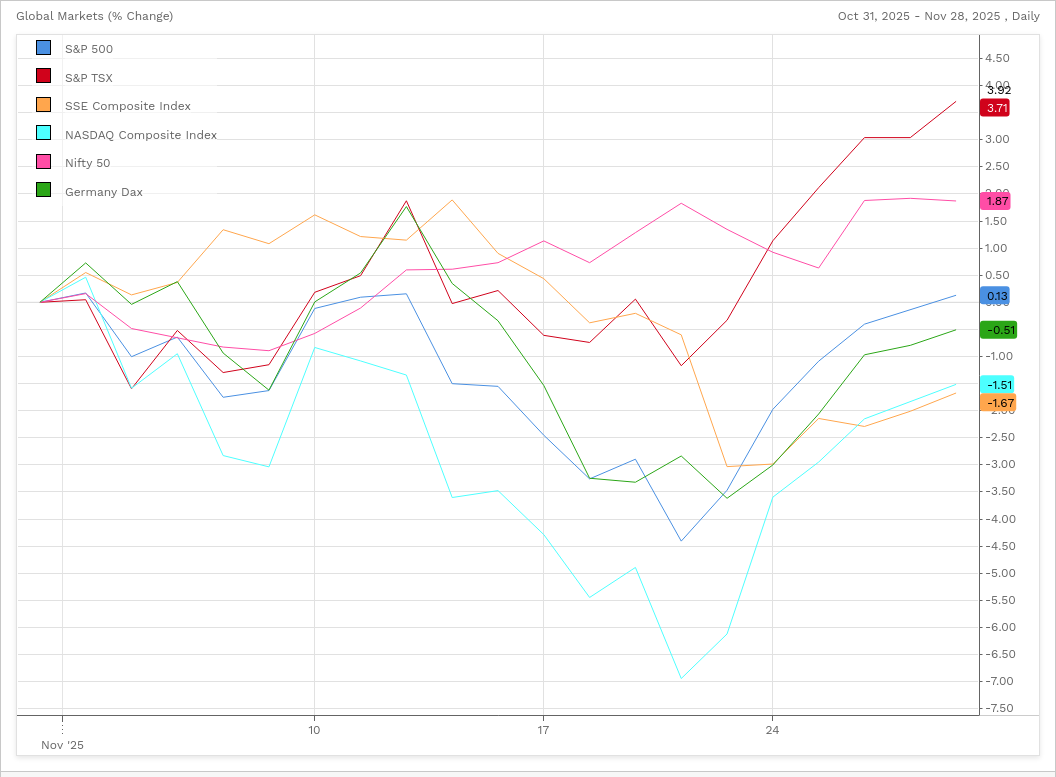 Source: FactSet® Source: FactSet® So far in December global stock markets are slightly up, but a strong Santa Claus Rally has not arrived yet. Investors still have ongoing concerns about an artificial intelligence spending bubble. Economic concerns amongst market participants have moderated now that U.S. government data reporting has resumed and has delivered mostly positive economic news. Investors were also buoyed by the U.S Federal Reserve interest rate cut announced earlier this month. As we move into 2026, many of the same market themes will persist. Artificial intelligence will continue to be a major economic driver. Although the magnitude of the U.S. tariffs has been watered down by trade negotiations, the tariff conversation will continue. The U.S. Supreme Court will decide on the legality of tariffs enacted under the International Emergency Economic Powers Act. U.S. inflation declined in November, but there are many areas such as healthcare, automobile, and many consumer goods that are experiencing upward pricing pressure. We also have U.S. Mid-Term elections in November which could change the balance of power in the U.S. Congress and the U.S. Senate. The Canada-U.S.-Mexico trade pact will also be negotiated in 2026. On top of all the expected events in 2026, investors must continue to expect the unexpected. Happy Holidays! Global Annual GDP Growth Rates after Trump’s Tariffs Declining Economies (among the six economies in our tracking) Change in Economic Growth after Trump’s Tariffs United States-0.2% Canada-0.9% China-0.6% Japan-0.2% Global Economic Growth (Annual GDP Growth Rate) – 1 Year Chart (*Dotted line shows the start of Trump’s Tariffs, February 4th) The U.S. economy’s (blue) annual growth rate declined from 2.5% to 2.3%. The Canadian economy’s (red) annual growth rate declined from 2.3% to 1.4%. China’s annual economic growth rate (brown) fell from 5.4% to 4.8%. The Japanese annual economic growth rate (yellow) declined from 1.30% to 1.10%. The Eurozone’s annual economic growth rate (green) increased from 1.2% to 1.4%. India’s annual economic growth rate (purple) improved from 6.4% to 7.8%. 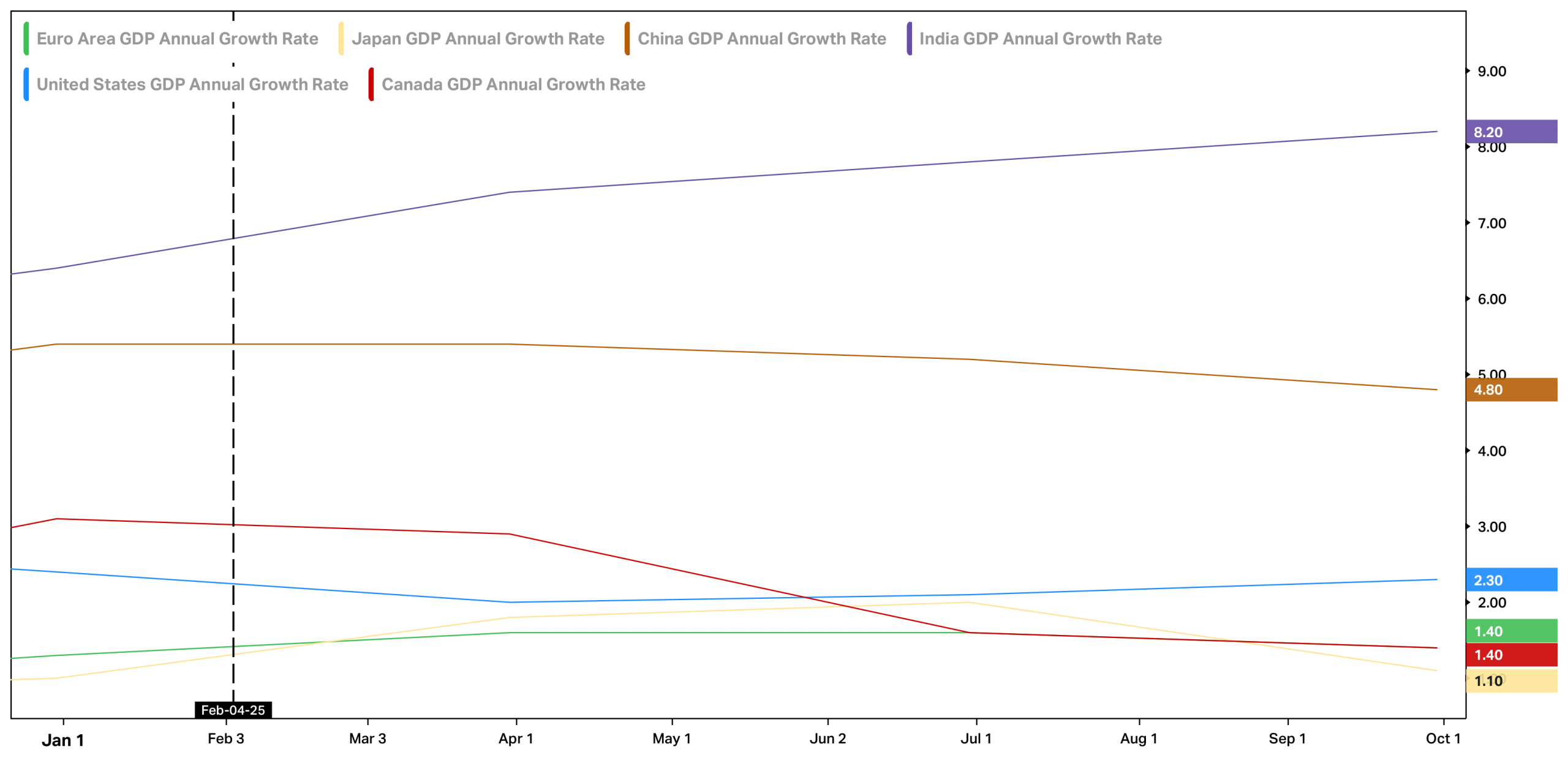 Source: Koyfin Source: Koyfin Global Annual Inflation Rates after Trump’s Tariffs Rising Inflation (among the six economies in our tracking) Economies with Rising Inflation after Trump’s Tariffs Canada+0.3% China+0.2% Global Inflation Rates (Annualized) – 1 Year Chart (*Dotted line shows the start of Trump’s Tariffs, February 4th) Since Trump’s Tariffs were implemented the inflation rate for all the tracked economies have moved lower except Canada and China. Canada’s inflation rate (red) has increased from 1.9% to 2.2%. China’s inflation rate (orange) increased from 0.5% to 0.7%.The United States’ inflation rate (blue) declined from 3.0% to 2.7%. The Eurozone inflation rate (green) fell from 2.5% to 2.1%. Japan’s inflation rate (yellow) decreased from 4.0% to 2.9%, and India’s inflation rate (purple) fell from 4.26% to 0.71%. 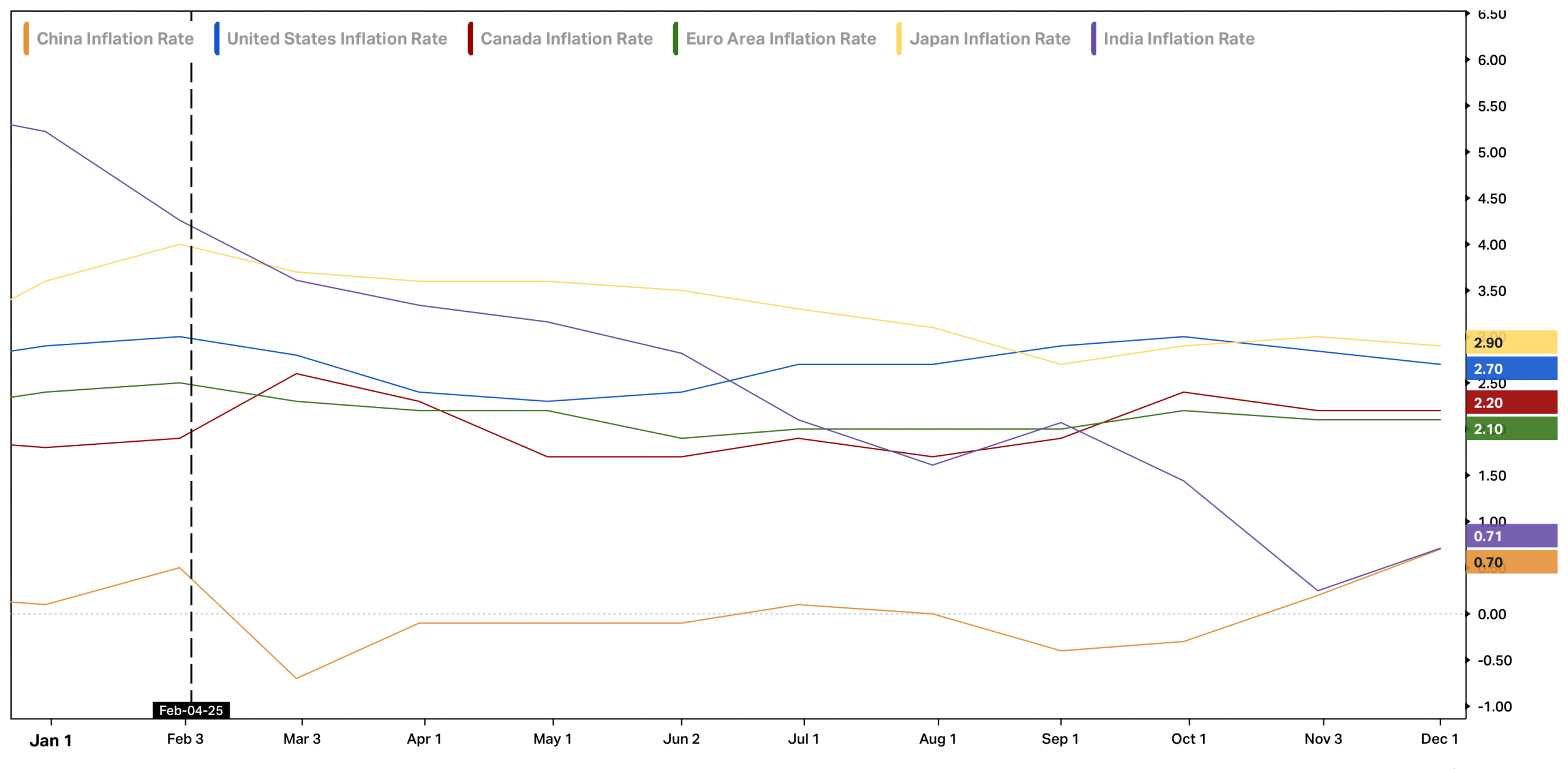 Source: Koyfin Source: Koyfin |
Trump’s Tariffs Note:
Additional tariffs on goods imported into the United States are expected to increase prices for American consumers and cut into the profits of American businesses. Nevertheless, the Trump administration has decided to utilize tariffs to achieve their priorities.
- Tariffs are being implemented to encourage companies to manufacture their products in the United States. The Trump administration expects that companies will eventually produce their products in the United States to avoid tariffs.
- The revenue from tariffs will be used to help pay for the One Big Beautiful Bill Act, passed on July 4th, 2025. The One Big Beautiful Bill act extends expiring tax reduction legislation, which was originally enacted in 2017 during Donald Trump’s first administration, along with other Republican Party priorities. The Congressional Budget Office estimates the cost of extending the 2017 tax cut legislation for ten additional years will be over $4 Trillion Dollars.
- Tariffs on U.S goods are being implemented to help eliminate the American trade deficit with other countries. The U.S. tariffs will be used as leverage to coerce other countries to lower their own tariffs and non-tariff barriers.
- Tariffs are being used as punishment for countries that refuse to carry out American demands on a range matters unrelated to trade.
Trump’s Tariffs Implemented in 2025
- 35% tariff on Canadian Goods (Except goods covered under the Canada-United States-Mexico trade agreement). Negotiations ongoing.
- 20% tariff on Chinese goods. Negotiations ongoing.
- 15% tariff on Japanese goods. Trade deal framework agreed upon
- 10% tariff on United Kingdom goods. Trade deal framework agreed upon.
- 15% tariff on European Union goods. Trade deal framework agreed upon.
- 15% tariff on Swiss and Liechtenstein goods. Trade deal framework agreed upon.
- 50% tariff on Indian goods.
- 25% tariff on Mexican Goods (Except goods covered under the Canada-United States-Mexico trade agreement). Negotiation deadline has been extended.
- 50% tariff on all iron, steel, and aluminum imports into the United States except for the United Kingdom and Russia which are tariffed at 25% and 200%, respectively.
- 50% tariff on copper imports into the United States.
- 25% tariff on automobiles and automobile parts into the United States, except for the United Kingdom and the European Union which are tariffed at 10% and 15%, respectively.
- 25% tariff on heavy duty trucks and 10% tariffs on all busses imported into the United States.
- 10% tariff on timber and lumber.
- 25% tariff on upholstered furniture, vanities, and cabinets.
- 10% tariff on all Canadian and Mexican potash imported into the United States that is not covered under the Canada-United States-Mexico trade agreement.
- 10% – 41% tariffs on all other trading partners based on the size of their trade deficit with the United States.
Conditions under which Trump’s Tariffs will be Lowered or Eliminated
- Legal: Trump’s tariffs mostly contravene international trade law, but enforcing these laws can be a long, tedious process often with no enforceable remedies. American industries that are impacted by Trump’s tariffs often have lobby groups that can challenge the legality of the Trump’s Tariffs in U.S. courts. The United States Congress could also intervene, since tariffs are typically under their purview, but Republicans have a majority in Congress and are unlikely to move against their party leader.
- Political Backlash: The negative impact of higher consumer prices in the United States and/or the unavailability of needed/desired goods due to retaliatory actions taken by other countries may generate political backlash from U.S. consumers and businesses.
- Trade Negotiations: At any time, trade negotiations between the United States and its trading partners around the world could lower or eliminate the newly enacted tariffs.
- U.S. Midterm Elections: In November 2026, U.S. Congressional Elections may change the political environment. If American voters are unhappy with how the Trump’s Tariffs are impacting their lives, Republicans could lose their majority in Congress.
- Four Year Presidential Term: In less than four years Donald Trump will complete his second and final term as the President of the United States of America. A newly elected American President could undo the Trump’s Tariffs, if they are still in place.
* The legality of Trump’s Tariff’s enacted under the International Emergency Economic Powers Act (IEEPA) were heard by the U.S. Supreme Court on November 5, 2025. The Supreme Court will announce their ruling in the coming weeks.
1 (Source: Bank of Canada)
2(Source: Statistics Canada)
3(Source: United States Bureau of Labour Statistics)
4(Source: United States Federal Reserve)
5(Source: United States Census Bureau)
6(Source: FactSet as of September 30,2025, 5:00 PM)
* This information has been prepared by Desmond Rubie, BCom, FCSI®, CIM®, CFP®, who is a Wealth Advisor for Rubie Wealth Management Group at iA Private Wealth. Opinions expressed in this article are those of Desmond Rubie, BCom, FCSI®, CIM®, CFP® only and do not necessarily reflect those of iA Private Wealth Inc.
*IA Private Wealth Inc. is a member of the Canadian Investor Protection Fund and the Canadian Investment Regulatory Organization. iA Private Wealth is a trademark and business name under which iA Private Wealth Inc. operates.

Desmond Rubie, BCom, FCSI®, CIM®, CFP®
Wealth Advisor
Rubie Wealth Management Group | iA Private Wealth
Insurance Advisor | iA Private Wealth Insurance*
26 Wellington Street East, 2nd Floor
Toronto, ON M5E 1S2
T: 647-429-3281 ext. 240018
Desmond.Rubie@iaprivatewealth.ca
Fellow of CSI (FCSI®)
iA Private Wealth Inc. is a member of the Canadian Investor Protection Fund and the Canadian Investment Regulatory Organization. iA Private Wealth is a trademark and business name under which iA Private Wealth Inc. operates.
*Insurance products are provided through iA Private Wealth Insurance, which is a trade name of PPI Management Inc. Only products and services offered through iA Private Wealth Inc. are covered by the Canadian Investor Protection Fund.


Leave a Reply