
Monthly Market Analysis March 2026
Economy
United States
The United States lost -92,000 jobs in February (it should be noted that strike activity in the healthcare field added -12,000 to the job decline). The American labour market is now averaging 5,660 jobs/month over the last three months. The unemployment rate moved up marginally to 4.4% from 4.3%. A more positive trend for the U.S. labour market has been continuing jobless claims. Continuing jobless claims measures the number of Americans that have received unemployment benefits for at least two weeks; it fell from 196,000 during the week of October 25, 2025, to 185,000 the week of February 28, 2026.
America’s economic growth rate as measured by GDP is declining. The latest estimate of the GDP growth rate for the fourth quarter of 2025 revealed that the U.S. economy grew at the slower pace of 0.7% compared to the previous estimate of 1.4%. We will get an initial reading on the GDP growth rate for the first quarter of 2026 at the end of April.
Consumer spending is yet another weak point in the U.S. economy. In the month of January, U.S. retail sales were down by -0.2%.
The level of inflation continues to be a concern for the U.S. Federal Reserve. In February, the U.S. inflation rate held steady at 2.4%, which influenced the voting members of the U.S. Federal Reserve to keep interest rates unchanged (3.75%) in their latest meeting on March 18th.
Canada
The Canadian economy lost an additional -83,900 jobs in February after losing -24,800 in January. The unemployment rate increased from 6.5% to 6.7% in February.
Although Canadian consumer credit is close to an all-time high ($810 Billion), Canadian consumers continue to spend. February retail sales increased by 0.9% in February after increasing 1.1% in January.
The rate of inflation in Canada fell from 2.3% to 1.8% in February. Falling inflation did not motivate the Bank of Canada to lower interest rates in their March 18th meeting, as they kept the Overnight Interest Rate unchanged at 2.25%. The Bank of Canada may need to consider cutting interest rates to help stimulate the weak Canadian job market when they meet again in May.
Markets
Global Stock Markets
Change in Global Stock Markets March 1 – 15, 2026
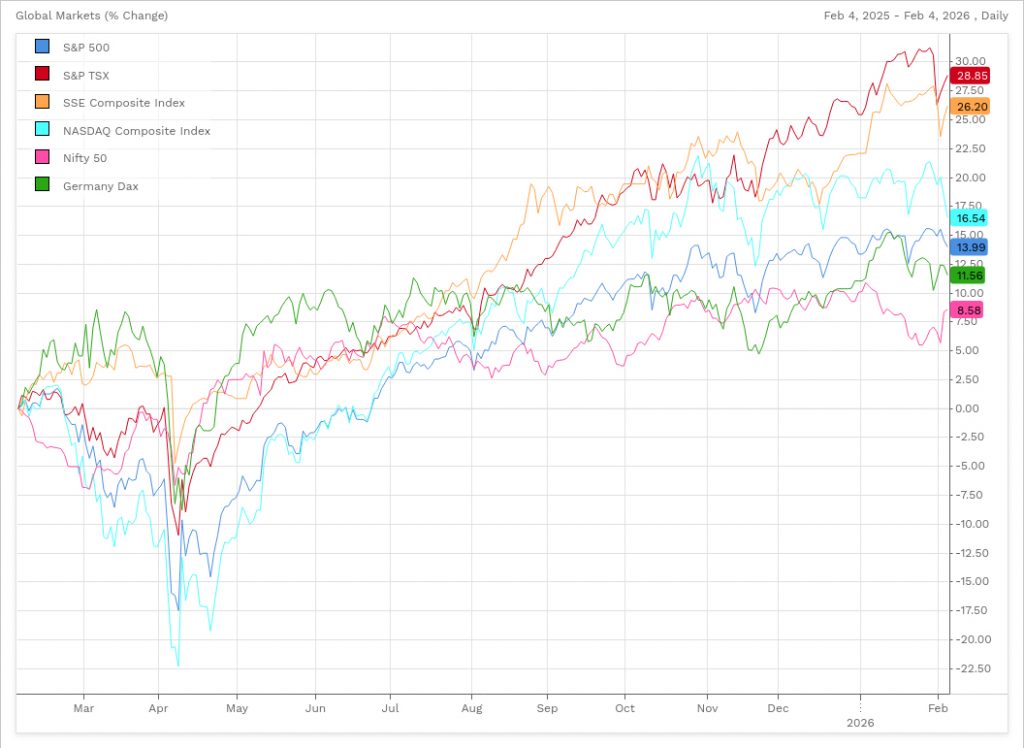
In March, we have seen heightened volatility in global markets. The ongoing war in Iran has rattled markets which were previously concerned about the impact of artificial intelligence on the global economy. Investors are now concerned about the price of oil and its impact on inflation.
In the first two weeks of March, the U.S. Market (S&P 500) fell by -3.59%, while the Canadian market (S&P/TSX Composite Index) dropped by -5.24%. The U.S. Nasdaq Composite index which contains a high weighting of technology related stocks decreased by -2.48%. The German stock market (Dax 40 index) fell by -7.27%. The Chinese market (Shanghai Composite Index) declined by -1.62% and the Indian market (Nifty 50 Index) fell by -8.05%.
If we do not see any further escalation of the Iran war, global equity and bond markets will eventually adjust to the expected negative economic effects of higher inflation and gasoline prices. The economic importance of middle east oil infrastructure will likely result in a gradual slowing of the war’s intensity, leading to a truce over the coming weeks. It is unlikely that markets will completely rebound until the bombing ends, the talking starts, and a tentative agreement between the U.S. and Iran unfolds.
Trumps’ Tariffs
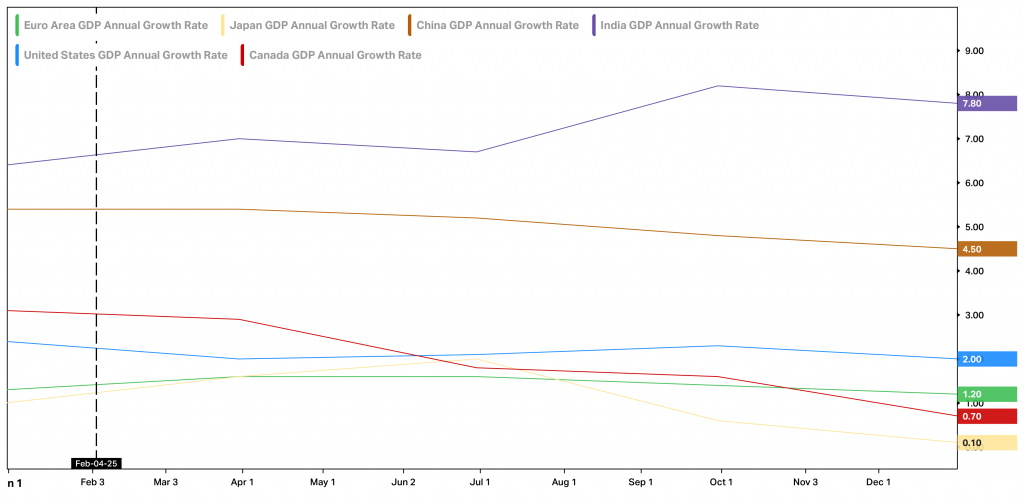
Global Annual GDP Growth Rates after Trump’s Tariffs
Declining Economies (among the six economies in our tracking)
| Change in Economic Growth after Trump’s Tariffs | |
| United States | -0.5% |
| Canada | -1.8% |
| China | -0.9% |
| Eurozone | -0.1% |
| Japan | -1.2% |
Global Economic Growth (Annual GDP Growth Rate) – 1 Year Chart
(*Ending December 2025. Dotted line shows the start of Trump’s Tariffs, February 4th, 2025)
The U.S. economy’s (blue) annual growth rate declined from 2.5% to 2.0%. The Canadian (red) annual economic growth rate declined from 2.3% to 0.7%. China’s annual economic growth rate (brown) fell from 5.4% to 4.5%. The Eurozone’s annual economic growth rate (green) decreased from 1.3% to 1.2%. The Japanese annual economic growth rate (yellow) declined from 1.30% to 0.10%. India’s annual economic growth rate (purple) improved from 6.4% to 7.8%.
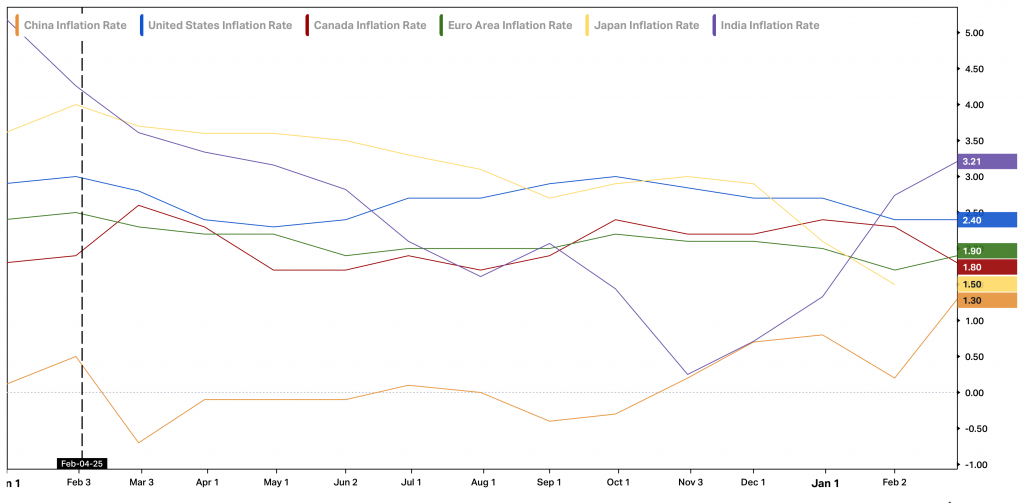
Global Annual Inflation Rates after Trump’s Tariffs
Rising Inflation (among the six economies in our tracking)
| Economies with Rising Inflation after Trump’s Tariffs | |
| China | +0.8% |
Global Inflation Rates (Annualized) – 1 Year Chart
(*Ending February 2026. Dotted line shows the start of Trump’s Tariffs, February 4th, 2025)
Since Trump’s Tariffs were implemented the inflation rate for all the tracked economies have moved lower except China. China’s inflation rate (orange) Increased from 0.5% to 1.3%. Canada’s inflation rate (red) Decreased from 1.9% to 1.8%. The United States’ inflation rate (blue) declined from 3.0% to 2.4%. The Eurozone inflation rate (green) fell from 2.5% to 1.9%. Japan’s inflation rate (yellow) decreased from 4.0% to 1.5%, and India’s inflation rate (purple) fell from 4.26% to 3.21%.
Trump’s Tariffs Note:
Additional tariffs on goods imported into the United States are expected to increase prices for American consumers and cut into the profits of American businesses. Nevertheless, the Trump administration has decided to utilize tariffs to achieve their priorities.
- Tariffs are being implemented to encourage companies to manufacture their products in the United States. The Trump administration expects that companies will eventually produce their products in the United States to avoid tariffs.
- The revenue from tariffs will be used to help pay for the One Big Beautiful Bill Act, passed on July 4th, 2025. The One Big Beautiful Bill act extends expiring tax reduction legislation, which was originally enacted in 2017 during Donald Trump’s first administration, along with other Republican Party priorities. The Congressional Budget Office estimates the cost of extending the 2017 tax cut legislation for ten additional years will be over $4 Trillion Dollars.
- Tariffs on U.S goods are being implemented to help eliminate the American trade deficit with other countries. The U.S. tariffs will be used as leverage to coerce other countries to lower their own tariffs and non-tariff barriers.
- Tariffs are being used as punishment for countries that refuse to carry out American demands on a range matters unrelated to trade.
Trump’s Tariffs Implemented in 2025
- 35% tariff on Canadian Goods (Except goods covered under the Canada-United States-Mexico trade agreement). Negotiations ongoing.
- 20% tariff on Chinese goods. Negotiations ongoing.
- 15% tariff on Japanese goods. Trade deal framework agreed upon
- 10% tariff on United Kingdom goods. Trade deal framework agreed upon.
- 15% tariff on European Union goods. Trade deal framework agreed upon.
- 15% tariff on Swiss and Liechtenstein goods. Trade deal framework agreed upon.
- 50% tariff on Indian goods.
- 25% tariff on Mexican Goods (Except goods covered under the Canada-United States-Mexico trade agreement).Negotiation deadline has been extended.
- 50% tariff on all iron, steel, and aluminum imports into the United States except for the United Kingdom and Russia which are tariffed at 25% and 200%, respectively.
- 50% tariff on copper imports into the United States.
- 25% tariff on automobiles and automobile parts into the United States, except for the United Kingdom and the European Union which are tariffed at 10% and 15%, respectively.
- 25% tariff on heavy duty trucks and 10% tariffs on all busses imported into the United States.
- 10% tariff on timber and lumber.
- 25% tariff on upholstered furniture, vanities, and cabinets.
- 10% tariff on all Canadian and Mexican potash imported into the United States that is not covered under the Canada-United States-Mexico trade agreement.
- 10% – 41% tariffs on all other trading partners based on the size of their trade deficit with the United States.
Conditions under which Trump’s Tariffs will be Lowered or Eliminated
- Legal: On February 20 , 2026, the U.S. Supreme Court ruled against the legality of Trump’s Tariff’s enacted under the International Emergency Economic Powers Act (IEEPA). The U.S. Supreme Court ruled that the President does not have the authority to levy tariffs under IEEPA
- Political Backlash: The negative impact of higher consumer prices in the United States and/or the unavailability of needed/desired goods due to retaliatory actions taken by other countries may generate political backlash from U.S. consumers and businesses.
- Trade Negotiations: At any time, trade negotiations between the United States and its trading partners around the world could lower or eliminate the newly enacted tariffs.
- U.S. Midterm Elections: In November 2026, U.S. Congressional Elections may change the political environment. If American voters are unhappy with how the Trump’s Tariffs are impacting their lives, Republicans could lose their majority in Congress.
- Four Year Presidential Term: In less than four years Donald Trump will complete his second and final term as the President of the United States of America. A newly elected American President could undo the Trump’s Tariffs, if they are still in place.
1 (Source: Bank of Canada)
2(Source: Statistics Canada)
3(Source: United States Bureau of Labour Statistics)
4(Source: United States Federal Reserve)
5(Source: United States Census Bureau)
6(Source: FactSet as of February 13th, 5:00 PM)
* This information has been prepared by Desmond Rubie, BCom, FCSI®, CIM®, CFP®, who is a Wealth Advisor for Rubie Wealth Management Group at iA Private Wealth. Opinions expressed in this article are those of Desmond Rubie, BCom, FCSI®, CIM®, CFP® only and do not necessarily reflect those of iA Private Wealth Inc.
*IA Private Wealth Inc. is a member of the Canadian Investor Protection Fund and the Canadian Investment Regulatory Organization. iA Private Wealth is a trademark and business name under which iA Private Wealth Inc. operates.

Desmond Rubie, BCom, FCSI®, CIM®, CFP®
Wealth Advisor
Rubie Wealth Management Group | iA Private Wealth
Insurance Advisor | iA Private Wealth Insurance*
26 Wellington Street East, 2nd Floor
Toronto, ON M5E 1S2
T: 647-429-3281 ext. 240018 | M: 416-795-6100
Desmond.Rubie@iaprivatewealth.ca
Fellow of CSI (FCSI®)
iA Private Wealth Inc. is a member of the Canadian Investor Protection Fund and the Canadian Investment Regulatory Organization. iA Private Wealth is a trademark and business name under which iA Private Wealth Inc. operates.
*Insurance products are provided through iA Private Wealth Insurance, which is a trade name of PPI Management Inc. Only products and services offered through iA Private Wealth Inc. are covered by the Canadian Investor Protection Fund.


Leave a Reply