
 Monthly Economic & Market Analysis October 2026 Global Economy United States The American economy slowed in the second quarter of this year, falling from a quarterly GDP growth rate of 2.5% down to 2.2%. We will get insight into the pace of growth for the third quarter of 2026 on October 29, when the U.S. Bureau of Economic Analysis releases its initial estimate of third quarter growth.4 The U.S. labour market increased by a less than expected 29,000 jobs in September slowing from the 133,000 jobs added in August. The unemployment rate increased from 4.1% to 4.2% during the month of September. Employment growth was primarily in the healthcare, construction, and manufacturing sectors.3 U.S. consumer spending rebounded in August as retail sales grew 1.2% after falling -0.5% in July. Retail sales were led by a pickup in spending at gas stations, restaurants & bars, furniture stores, and electronics stores.4 The U.S. inflation rate held steady at 3.4% in August despite renewed military activity in Iran. The U.S. Federal Reserve acted on their quest to bring the inflation rate down to 2%. In their September 16 interest rate policy meeting, the U.S. Federal Reserve raised the federal funds rate from 3.75% to 4.0%. Given the economic slowing effects of higher interest rates and the weak job growth data in September, expectations are low that the U.S. Federal Reserve will raise rates in their upcoming meeting on October 28th.4 Canada The Canadian economy’s quarterly growth rate in the second quarter of this year was a higher than expected 3.3%. We will get data on the performance of the Canadian economy during the third quarter of 2026 on November 30.1After adding 75,100 jobs in July, the Canadian economy lost -41,700 jobs in August. The unemployment rate was unchanged at 6.4%.Job losses were highest in the service, utilities, and natural resources sectors. 1 Consumer spending rebounded in August as preliminary retail sales were estimated to have grown by 1.3%.1 Canada’s inflation rate was unchanged at 3.0% in August. The Bank of Canada was not overly concerned about the level of inflation as they held Canda’s overnight rate at 2.25% in their September 2nd meeting. It is the seventh consecutive meeting where the Bank of Canada has left interest rates unchanged. A higher inflation reading on October 19, could possibly influence the Bank of Canada to increase the overnight rate when they meet on October 28. 1 Eurozone The Eurozone’s 2026 annualized economic (GDP) growth rate improved from 0% in the first quarter to 2.6% in the second quarter. Eurostat will provide data on the third quarter GDP growth rate on October 30.7 The number of employed people in the Eurozone grew by 0.1% to 176,577 million people in the second quarter of this year, which was equal to the 0.1% growth rate achieved in the first quarter. Eurozone employment growth was led by job gains in Spain and France but hindered by job losses in Germany. The Eurozone unemployment rate held steady at 6.4% in August.7 Eurozone consumers cut back on spending in July, as retail sales fell -0.6%, driven by a decline in non-food products and fuel.7 Energy prices continued to push the Eurozone inflation rate higher in September, climbing from 3.2% to 3.8%. September was the Eurozone’s third consecutive month of higher inflation. The European Central Bank’s concern with the inflation rate drifting further away from their 2% target rate influenced their decision to raise rates from 2.4% to 2.65% on the 10th of September.7 China The Chinese economy grew at a slower pace in the second quarter of this year, falling from a quarterly GDP growth rate of 5.0% in the first quarter to 4.3% in the second quarter. Chinese third quarter GDP growth will be released by the National Bureau of Statistics of China on October 19.8 China’s unemployment rate increased for the third consecutive month in August, jumping from 5.2% to 5.3%.8 Chinese consumers cut back on spending in August as retail sales fell by -0.13%.8 The People’s Bank of China kept its 1-year loan prime rate at 3% in September. It has been unchanged since May 2025.8 Markets Global Stock Markets Change in Global Stock Markets September 1 – 30, 2026 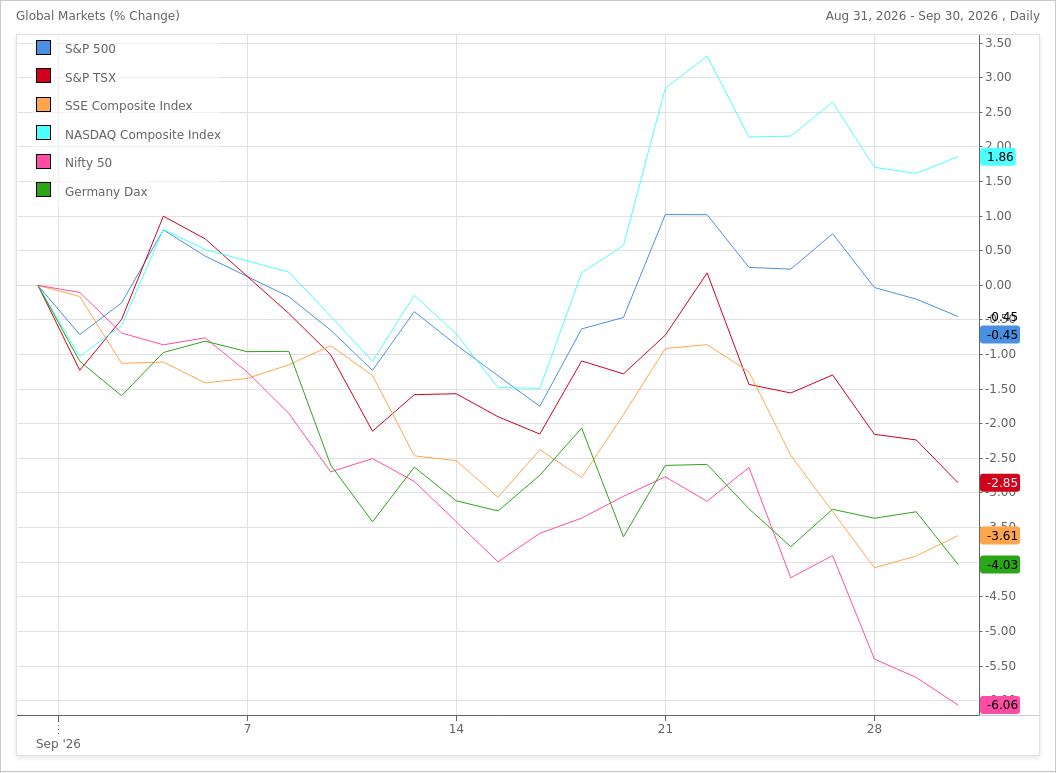 Source: FactSet® In the month of September, the U.S. market (S&P 500) fell -0.45%, the Canadian market (S&P/TSX Composite Index) declined -2.85%. The U.S. Nasdaq Composite index which contains a high weighting of technology related stocks increased 1.86%. The German stock market (Dax 40 index) fell -4.03%. The Chinese market (Shanghai Composite Index) dropped -3.61% and the Indian market (Nifty 50 Index) declined -6.06%. Jittery markets were led by bond market investors who continue to be concerned about higher inflation rates, higher oil prices, and ballooning government deficits. The 0.25% rate hike by the U.S. Federal Reserve in September was highly expected by market participants, which minimized the impact on market volatility. Technology stocks led stock market performance in September as investors gravitated towards the sector again despite concerns about the dangers of AI and backlash against AI data centres. Gold and silver had a weak month in September, falling -6.52% and -9.31% respectively (FactSet®). The precious metal prices were impacted by rising bond yields and a rising U.S. dollar. The Canadian dollar fell -2.67% (FactSet®) against the U.S. dollar in September. As we move into earnings seasons this October, investors should begin to assess the broader market more favourably if corporate earnings continue to provide double digit growth rates as they have for the last eight quarters (FactSet®). 1 (Source: Bank of Canada) 2(Source: Statistics Canada) 3(Source: United States Bureau of Labour Statistics) 4(Source: United States Bureau of Economic Analysis) 5(Source: United States Federal Reserve) 6(Source: United States Census Bureau) 7(Source: Eurostat) 8(Source: National Bureau of Statistics of China) 9(Source: FactSet as of September 30, 5:00 PM) This information has been prepared by Desmond Rubie, BCom, FCSI®, CIM®, CFP® who is a Wealth Advisor for iA Private Wealth Inc. and does not necessarily reflect the opinion of iA Private Wealth. The information contained in this newsletter comes from sources we believe reliable, but we cannot guarantee its accuracy or reliability. The opinions expressed are based on an analysis and interpretation dating from the date of publication and are subject to change without notice. Furthermore, they do not constitute an offer or solicitation to buy or sell any of the securities mentioned. The information contained herein may not apply to all types of investors. The Wealth Advisor can open accounts only in the provinces in which they are registered. IA Private Wealth Inc. is a member of the Canadian Investor Protection Fund and the Canadian Investment Regulatory Organization. iA Private Wealth is a trademark and business name under which iA Private Wealth Inc. operates. * Insurance products are provided through iA Private Wealth Insurance, which is a trade name of PPI Management Inc. Only products and services offered through iA Private Wealth Inc. are covered by the Canadian Investor Protection Fund. Desmond Rubie, BCom, FCSI®, CIM®, CFP® Wealth Advisor Rubie Wealth Management Group | iA Private Wealth Insurance Advisor | iA Private Wealth Insurance* 26 Wellington Street East, 2nd Floor, Toronto, ON M5E 1S2 Direct: 416-203-2228 Office: 416-203-2226 Fax: 416-613-8921 Desmond.Rubie@iaprivatewealth.ca rubiewealth.com |

Insight Categories
- Economy
- Estate Planning
- Financial Literacy
- Insurance
- Investment Management
- Markets
- Philanthropy
- Tax Planning
Insight Archive
- October 2026
- September 2026
- August 2026
- July 2026
- June 2026
- May 2026
- April 2026
- March 2026
- February 2026
- January 2026
- December 2025
- November 2025
- October 2025
- September 2025
- August 2025
- July 2025
- June 2025
- May 2025
- April 2025
- March 2025
- February 2025
- January 2025
- December 2024
- November 2024
- October 2024
- September 2024
- August 2024
- July 2024
- June 2024
Site Map
- About
- Business Succession
- Case Studies
- Cash Flow Management
- Charitable Giving
- Contact
- Education Planning
- Estate Planning
- Events
- History
- Insights
- Investment Management
- Log in
- News
- Our Team
- Philosophy
- Retirement Living
- Retirement Planning
- Risk Management
- Socially Responsible Investing
- Solutions
- UK Pension Transfers (QROPS)
- Video
- What We Do


Leave a Reply