
Monthly Economic & Market Analysis November 2026 Global Economy United States The U.S. economy continues to show resilience as its third quarter annual GDP growth rate improved from the second quarter’s annual pace of growth from 2.2% to 3.4%. The American economy is now growing at its fastest quarterly pace since the third quarter of 2025. Investment in artificial intelligence equipment and computers were big contributors to third quarter economic growth.4 The U.S. labour market added a less than expected 29,000 jobs in September slowing from the 133,000 jobs added in August. The unemployment rate increased from 4.1% to 4.2% during the month of September. Employment growth was primarily in the healthcare, construction, and manufacturing sectors.3 American consumers continued to dig deep into their pockets in September as retails sales grew by 0.8% after growing by 1.2% in August. As we have seen in recent months, increased spending at gas stations was the largest contributor to September’s retail sales.6 The U.S. inflation rate increased from 3.4% to 3.7% in September mostly reflecting higher fuel prices. Despite the higher inflation reading, the U.S. Federal Reserve decided not to raise interest rates in their October 28 meeting.4,5 Canada The Canadian economy’s quarterly growth rate in the second quarter of this year was a higher than expected 3.3%. We will get data on the performance of the Canadian economy during the third quarter of 2026 on November 30.1 The Canadian labour market suffered its second consecutive month of job losses in September. The Canadian economy lost -68,300 jobs in September, following the -41,700 jobs that were lost in August. September’s job losses were primarily due to 70,000 jobs being eliminated in the public sector. The unemployment rate rose from 6.4% to 6.5%.1 Canadian consumers continued to spend freely for a second month. Retail sales grew by 0.7% in September after improving by a robust 1.2% in August. Consumer spending was led by new automobile and automobile part purchases.1 Canada’s inflation rate increased marginally from 3.0% to 3.1% in September, but the Bank of Canada expects inflation to increase over the coming months. The Bank of Canada is also worried about the impact of new tariffs on the economy, but their overriding concern is that inflation may seep into other parts of the Canadian economy, outside of the energy related areas. The Bank of Canada increased the Overnight Rate by 0.25% from 2.25% to 2.50% during their rate policy meeting on October 28. It is the first, rate increase since July 12, 2023. A higher and broader inflation reading on November 16 will likely be the determinant of another rate hike by the Bank of Canada in their next interest rate policy meeting on December 9.1,2 Eurozone The Eurozone’s third quarter annual GDP growth rate improved this year from the second quarter’s annual growth rate of 1.2% to 1.3%. It is the second consecutive quarter in which GDP growth has improved in the Eurozone. The stronger quarterly growth rate was derived from countries such as Germany, Spain, the Netherlands, Finland, Estonia, and Ireland.7 The number of employed people in the Eurozone grew by 0.1% to 176,448 million people in the second quarter of this year, which was equal to the 0.1% growth rate achieved in the first quarter. Employment growth improved in Spain, was flat in France, but declined in Italy and Germany. The Eurozone unemployment rate increased from 6.4% to 6.5% in September.7 Eurozone consumers increased spending marginally in August as retail sales grew by 0.1%, after falling by -0.6% in July. Interestingly, spending was lower on fuel and higher for essential everyday non-food items.7 Energy prices continued to push the Eurozone inflation rate higher in September, climbing from 3.2% to 3.8%. September was the Eurozone’s third consecutive month of higher inflation. Although, inflation was found to be on an upward trajectory the European Central Bank decided to hold the main financing rate at its current level of 2.65%, during their October 29th interest policy rate meeting.7 China The Chinese economy grew at a faster pace in the third quarter of this year. Annualized quarterly GDP growth improved from 4.3% in the second quarter to 4.5% in the third quarter. China’s economic growth was led by exports of technology products and parts, as well as electric vehicles.8 China’s unemployment rate fell from 5.3% to 5.2% in September.8 Chinese consumer spending rebounded in September as retail sales grew by 0.35%.8 The People’s Bank of China kept its 1-year loan prime rate at 3% in October. It has been unchanged since May 2025.8 Global Inflation Rates (2026) 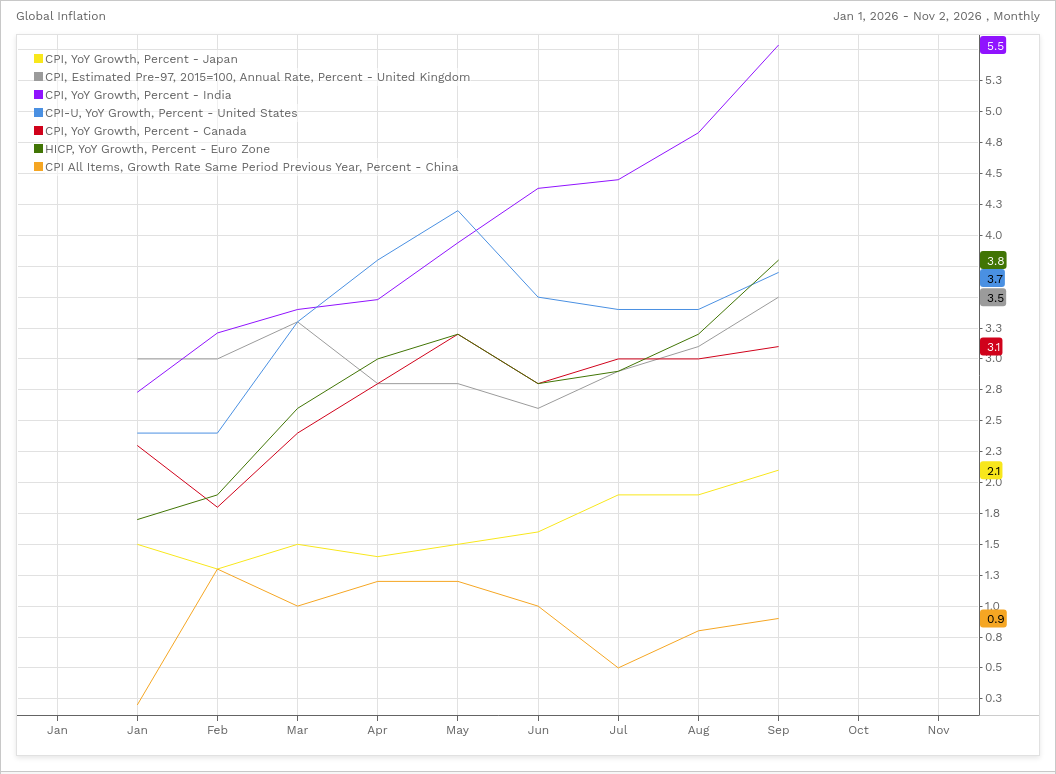 Source: FactSet® Central Bank Policy Rates (2026) 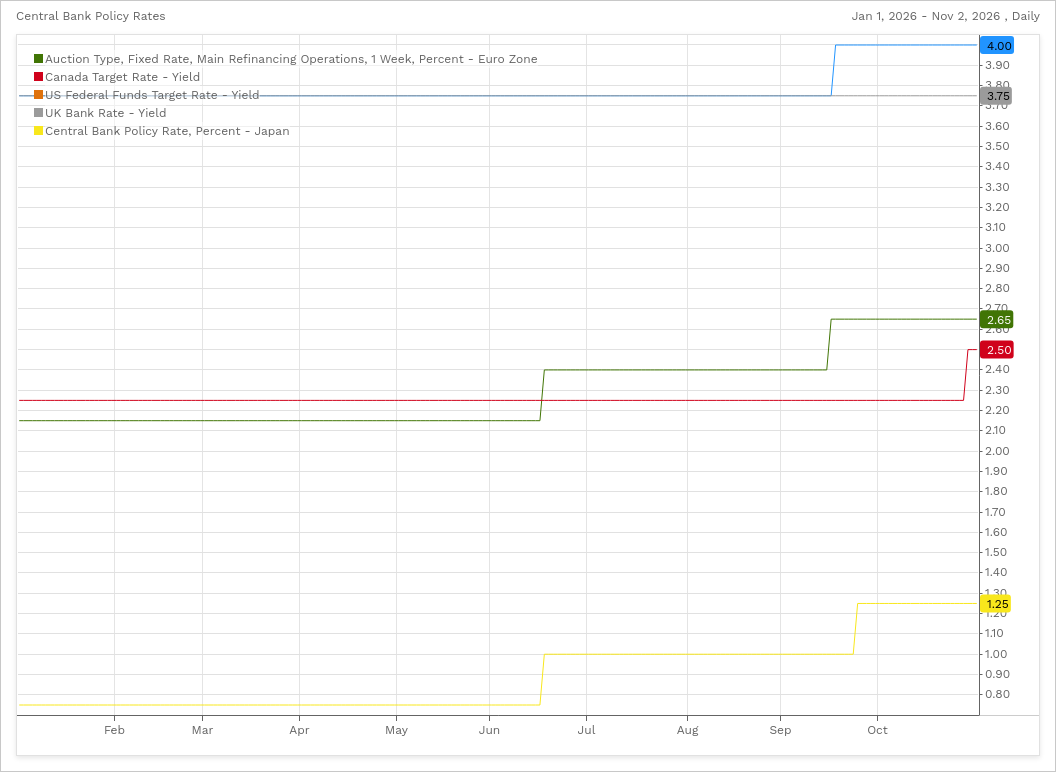 Source: FactSet® Markets Global Stock Markets Change in Global Stock Markets October 1 – 31, 2026 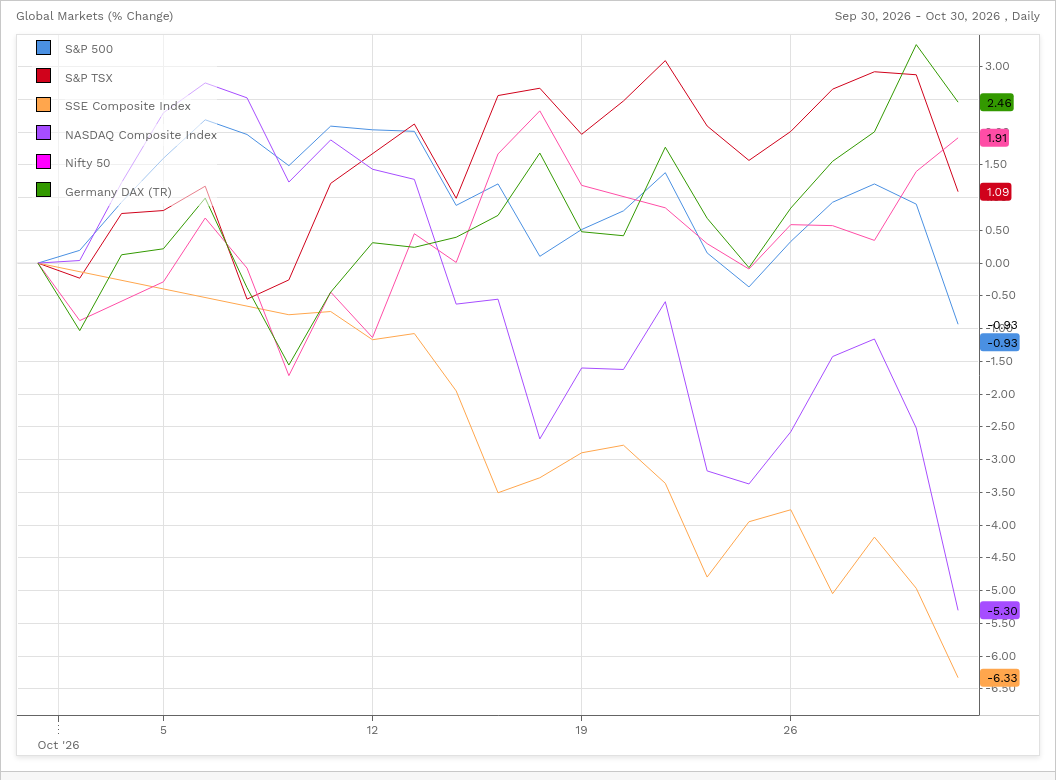 Source: FactSet® In the month of October, the U.S. market (S&P 500) declined by -0.93%, the Canadian market (S&P/TSX Composite Index) grew by 1.09%. The U.S. Nasdaq Composite index which contains a high weighting of technology related stocks sunk by -5.33%. The German stock market (Dax 40 index) rebounded 2.46%. The Chinese market (Shanghai Composite Index) fell by -6.33% and the Indian market (Nifty 50 Index) grew 1.91%. Equity markets were impacted by investors’ concerns about the viability of continued artificial intelligence capital spending, which has been a recurring market theme throughout 2026. In September investors were enthusiastic about AI companies, but once again got cold feet in October. Financial markets may have a short-term limited reaction to the U.S. midterm elections on November 3rd, but a change in the political balance of power will have more of an impact on industrial and foreign policy over the coming months. Conversations in the U.S. around tariffs, immigration and foreign intervention could possibly move in a different direction. We will get the answer to some of these questions shortly. 1 (Source: Bank of Canada) 2(Source: Statistics Canada) 3(Source: United States Bureau of Labour Statistics) 4(Source: United States Bureau of Economic Analysis) 5(Source: United States Federal Reserve) 6(Source: United States Census Bureau) 7(Source: Eurostat) 8(Source: National Bureau of Statistics of China) 9(Source: FactSet as of October 30, 5:00 PM) This information has been prepared by Desmond Rubie, BCom, FCSI®, CIM®, CFP® who is a Wealth Advisor for iA Private Wealth Inc. and does not necessarily reflect the opinion of iA Private Wealth. The information contained in this newsletter comes from sources we believe reliable, but we cannot guarantee its accuracy or reliability. The opinions expressed are based on an analysis and interpretation dating from the date of publication and are subject to change without notice. Furthermore, they do not constitute an offer or solicitation to buy or sell any of the securities mentioned. The information contained herein may not apply to all types of investors. The Wealth Advisor can open accounts only in the provinces in which they are registered. IA Private Wealth Inc. is a member of the Canadian Investor Protection Fund and the Canadian Investment Regulatory Organization. iA Private Wealth is a trademark and business name under which iA Private Wealth Inc. operates. * Insurance products are provided through iA Private Wealth Insurance, which is a trade name of PPI Management Inc. Only products and services offered through iA Private Wealth Inc. are covered by the Canadian Investor Protection Fund.  Desmond Rubie, BCom, FCSI®, CIM®, CFP® Wealth Advisor Rubie Wealth Management Group | iA Private Wealth Insurance Advisor | iA Private Wealth Insurance* 26 Wellington Street East, 2nd Floor, Toronto, ON M5E 1S2 Mobile: 416-795-6100 Direct: 416-203-2228 Office: 416-203-2226 Fax: 416-613-8921 Desmond.Rubie@iaprivatewealth.ca rubiewealth.com Fellow of CSI (FCSI®) |

Insight Categories
- Economy
- Estate Planning
- Financial Literacy
- Insurance
- Investment Management
- Markets
- Philanthropy
- Tax Planning
Insight Archive
- November 2026
- October 2026
- September 2026
- August 2026
- July 2026
- June 2026
- May 2026
- April 2026
- March 2026
- February 2026
- January 2026
- December 2025
- November 2025
- October 2025
- September 2025
- August 2025
- July 2025
- June 2025
- May 2025
- April 2025
- March 2025
- February 2025
- January 2025
- December 2024
- November 2024
- October 2024
- September 2024
- August 2024
- July 2024
- June 2024
Site Map
- About
- Business Succession
- Case Studies
- Cash Flow Management
- Charitable Giving
- Contact
- Education Planning
- Estate Planning
- Events
- History
- Insights
- Investment Management
- Log in
- News
- Our Team
- Philosophy
- Retirement Living
- Retirement Planning
- Risk Management
- Socially Responsible Investing
- Solutions
- UK Pension Transfers (QROPS)
- Video
- What We Do


Leave a Reply